
How to Train Lab Members on Peptide Handling
Structured peptide handling training is defined as a formal competency program that equips laboratory personnel with the technical skills, safety awareness, and protocol knowledge required to manage synthetic peptides without compromising sample integrity or research validity. For lab managers working in biomedical research, the decision to train lab members on peptide handling directly determines assay reproducibility, regulatory compliance, and the long-term reliability of experimental data. Peptides are chemically sensitive compounds. A single mishandled reconstitution or improper freeze-thaw cycle can degrade an entire batch, invalidating weeks of work. This guide provides a structured framework for building, executing, and sustaining a peptide handling training program that meets the operational demands of a working biomedical lab.
What are the essential components of peptide handling training programs?
Effective peptide handling training begins with the right infrastructure. Before any lab member touches a peptide vial, the lab must have standardized equipment, written SOPs, and a defined safety baseline in place.

Required equipment and materials
The core equipment list for solid-phase peptide synthesis workflows includes automated peptide synthesizers, specialized resins such as Wang and Rink amide, and coupling reagents including HBTU and HATU. Each of these components requires trained personnel to operate safely and correctly. Beyond synthesis equipment, storage infrastructure is non-negotiable. Lyophilized peptides require storage at –20°C, protected from heat, light, and moisture, which means every lab member must understand cryogenic storage protocols before independent handling is permitted. PPE requirements, labeling tools, and dedicated pipetting equipment for peptide solutions round out the minimum equipment baseline.
| Equipment / Prerequisite | Purpose | Training Requirement |
|---|---|---|
| Automated peptide synthesizer | SPPS workflow execution | Supervised operation certification |
| Storage freezers (–20°C) | Lyophilized peptide preservation | Storage and retrieval SOP sign-off |
| PPE (gloves, goggles, lab coat) | Chemical exposure protection | Safety induction before lab access |
| Labeling tools and cryovials | Sample traceability | Labeling protocol acknowledgment |
| TFA and coupling reagents | Cleavage and synthesis steps | Chemical hazard training completion |
SOP and safety prerequisites
Every training program requires written SOPs covering peptide synthesis, reconstitution, storage, and freeze-thaw management before training begins. Chemical hazard awareness is a non-negotiable prerequisite. Cleavage using ~95% TFA requires 30 to 90 minutes under Fmoc/tBu strategy, meaning lab members must understand both the timing requirements and the corrosive nature of the reagent before they perform this step independently. Institutional compliance policies, including any required safety certifications, must be completed and documented before hands-on peptide work begins.
How to conduct effective step-by-step training for peptide handling tasks
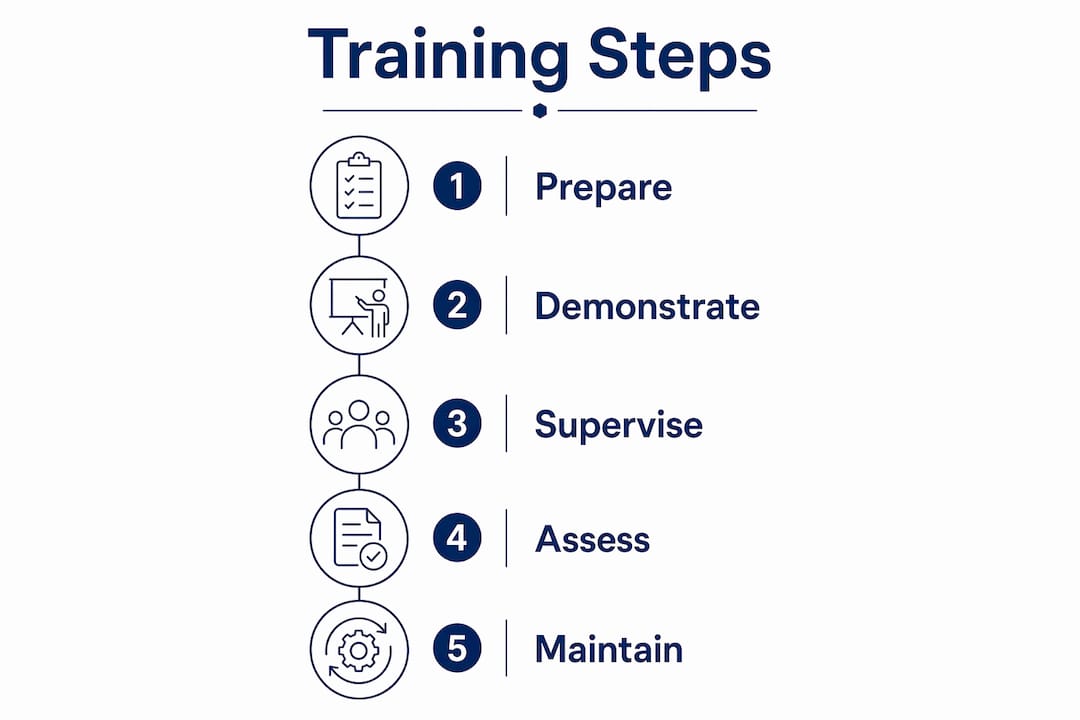
Competency in peptide handling is built through sequential exposure, not a single training session. The most reliable training structure follows three stages: demonstration by a qualified trainer, supervised execution by the trainee, and finally, independent handling with documented sign-off.
Core training sequence
- Pre-training orientation. Review all relevant SOPs with the trainee. Confirm completion of chemical hazard training, PPE protocols, and institutional safety requirements.
- Trainer demonstration. The qualified trainer performs each procedure in real time, narrating each step. Cover peptide reconstitution, solution preparation, aliquoting, and storage transfer.
- Supervised execution. The trainee performs each procedure under direct observation. The trainer documents errors and provides immediate corrective feedback.
- Independent trial with observation. The trainee completes a full handling sequence independently while the trainer observes without intervening. This step identifies gaps that supervised practice may mask.
- Competency sign-off. The trainer documents the trainee’s performance against defined criteria and signs off on the SOP acknowledgment form.
- Periodic review. Schedule a follow-up assessment at 30 days to confirm retained competency before the trainee handles high-value or limited-quantity peptides without supervision.
Key protocol areas to cover
Peptide reconstitution is the highest-risk handling step for most lab members. The peptide reconstitution protocol requires precise solvent selection, correct volume calculation, and proper mixing technique to avoid aggregation or degradation. Freeze-thaw management is equally critical. Repeated freeze-thaw cycles degrade peptide stability, so lab members must understand how to prepare single-use aliquots and why this practice protects both the sample and the data. Solution preparation, including pH adjustment and concentration verification, must also be covered with reference to the specific peptides in your lab’s catalog.
Pro Tip: Schedule the first supervised execution session immediately after the demonstration, not the following day. Retention of procedural steps drops significantly with a 24-hour gap between observation and practice.
The train-the-trainer approach
Train-the-trainer models empower proficient staff to lead training, promoting peer buy-in and building internal leadership capacity. This approach is particularly effective in labs with high staff turnover or multiple concurrent research projects. When a senior lab member becomes a certified internal trainer, the lab gains a scalable training resource that does not depend on external instruction. The trainer role also increases engagement and accountability in the staff member who holds it.
Common mistakes and how to prevent them
- Reconstituting peptides in the wrong solvent due to skipping the SOP review step
- Failing to centrifuge lyophilized peptides before opening the vial, causing powder loss
- Storing reconstituted peptides at room temperature during a busy workflow
- Mislabeling aliquots with incomplete batch or concentration information
- Skipping the equilibration step when removing peptides from –20°C storage, causing condensation-related contamination
Proper handling training reduces contamination risk and improves assay quality, which is directly tied to reproducible biomedical research outcomes. Each mistake on the list above has a corresponding SOP step that prevents it. Training must make that connection explicit.
What are the best practices for maintaining peptide handling proficiency?
Initial training establishes a baseline. Sustained proficiency requires a structured maintenance program that includes refresher training, cross-training, and documented competency assessments.
Refresher training timelines
Lab safety refresher training is standardized at intervals ranging from one to three years across most institutional programs. For peptide handling specifically, annual refreshers are appropriate for personnel who handle peptides regularly, while a two-year cycle may be acceptable for staff with infrequent exposure. The key principle is that refresher frequency should match handling frequency and risk level. A lab member who reconstitutes peptides weekly needs more frequent reinforcement than one who manages storage logistics only.
Cross-training and skills matrices
Cross-training builds team-wide competency and prevents critical knowledge bottlenecks when a key staff member is absent. A skills matrix is the most practical tool for tracking this. The matrix maps each lab member against each handling competency, making gaps visible and prioritizing training assignments. Cross-training also promotes equity within the team. When only one person knows how to perform a specific handling task, that person becomes a single point of failure. A skills matrix makes that risk visible before it becomes a problem.
Assessment and documentation methods
Competency maintenance depends on consistent assessment. The following methods provide a layered evaluation approach:
- Self-assessment checklists. Lab members review their own adherence to SOPs on a defined schedule, typically monthly. This builds self-awareness and flags emerging compliance gaps before they affect data.
- Supervised evaluations. A qualified trainer or lab manager observes a handling session without prior notice to the trainee. Unannounced observation captures real-world compliance more accurately than scheduled assessments.
- Documentation sign-off. Every completed training module, refresher session, and competency evaluation must be recorded with a dated signature. Version-controlled SOPs with training acknowledgments improve audit readiness and ensure consistency across the team.
- SOP adherence checks during high-workload periods. Compliance tends to drop when labs are busy. Scheduling brief spot-checks during peak periods identifies whether training has translated into durable habits or only performs well under low-pressure conditions.
Pro Tip: Build the skills matrix in a shared document that all lab members can view. Transparency about competency gaps motivates self-directed learning and reduces the social friction of being assigned to remedial training.
How to troubleshoot common challenges in peptide handling training
Even well-designed training programs encounter implementation problems. The most frequent challenges are SOP complexity, inconsistent compliance during high-workload periods, and staff resistance to retraining.
Identifying and resolving training failures
Training programs that align with actual lab workload and simplify SOPs produce higher compliance rates. When an SOP is too complex to follow during a busy experimental day, lab members will skip steps. The solution is not to lower standards but to redesign the SOP so that each step is executable under realistic conditions. A two-page SOP with clear decision points outperforms a ten-page document that no one reads under pressure.
| Challenge | Solution | Effectiveness |
|---|---|---|
| Overly complex SOPs | Simplify to decision-tree format with visual aids | High: reduces step-skipping under workload |
| Inconsistent compliance | Schedule spot-checks during peak periods | High: identifies real-world gaps |
| Staff resistance to retraining | Use train-the-trainer peer model | Medium-High: peer delivery reduces resistance |
| Knowledge bottlenecks | Implement cross-training with skills matrix | High: builds redundancy and team resilience |
| Poor documentation practices | Require version-controlled SOP sign-offs | High: improves audit readiness and accountability |
Documentation as a training tool
Version control and training sign-offs prevent audit confusion and create a traceable record of each lab member’s competency history. Documentation serves a dual function. It protects the lab during institutional audits and provides the lab manager with a clear picture of where training has succeeded and where it needs reinforcement. Performance feedback loops, where trainers review documentation with trainees and identify patterns, convert records from passive compliance tools into active training assets.
Pro Tip: When introducing a revised SOP, hold a brief 15-minute team review session before the new version goes live. This prevents the common scenario where lab members continue following the old version because they were never formally notified of the change.
For labs evaluating peptide quality benchmarks as part of their procurement and training integration, aligning supplier documentation standards with internal SOP requirements reduces the gap between vendor specifications and lab practice.
Key takeaways
Effective peptide handling training requires structured sequencing, documented competency assessment, and a continuous maintenance cycle to sustain accuracy and compliance across the lab team.
| Point | Details |
|---|---|
| Establish prerequisites first | Complete safety induction, SOP review, and chemical hazard training before any hands-on peptide work. |
| Use sequential training stages | Move from demonstration to supervised execution to independent handling with documented sign-off at each stage. |
| Implement train-the-trainer | Empower proficient staff as internal trainers to build scalable, peer-driven training capacity. |
| Schedule refreshers systematically | Annual refreshers for frequent handlers; cross-training with a skills matrix prevents knowledge bottlenecks. |
| Simplify SOPs for compliance | SOPs designed for realistic workload conditions produce higher adherence than complex documents. |
Our perspective on building training programs that actually hold
We have observed a consistent pattern across biomedical labs: training is treated as an event rather than a system. A new lab member completes an orientation, signs an acknowledgment form, and is then expected to maintain competency indefinitely without structured reinforcement. The result is predictable. Compliance holds during the first few months and then erodes quietly as workload increases and habits drift.
The labs that sustain high handling accuracy over time share one structural feature: they treat training as a recurring operational cycle, not a one-time onboarding task. Refresher sessions are scheduled in advance, not triggered by errors. Skills matrices are reviewed quarterly, not annually. The train-the-trainer model is used not just to scale instruction but to create a culture where technical precision is a shared professional value, not a compliance checkbox.
We also advocate for customizing training to individual staff profiles. A postdoctoral researcher with five years of peptide synthesis experience needs a different training path than a new graduate student handling lyophilized compounds for the first time. Applying the same generic SOP walkthrough to both wastes time and misses the specific gaps each person actually has. Assess first, then train to the gap.
The most durable training programs we have seen also balance protocol rigor with operational reality. A lab that enforces every SOP step during a low-pressure training session but allows shortcuts during a high-throughput experimental run has not built a training program. It has built a performance. Real competency shows up under pressure, which is exactly why spot-checks during busy periods are the most informative assessment tool available.
— Vertex
Supporting your lab’s peptide research with verified materials
When your team is trained and your protocols are in place, the quality of your research materials becomes the next critical variable. Vertexpeptideslab provides research-use-only synthetic peptides with Certificates of Analysis verifying purity above 99% through third-party HPLC and LC-MS testing. Every batch in the catalog, including TB-500, IGF-1 LR3, and Ipamorelin, is supported by full documentation for traceability and audit compliance.
Lab managers integrating supplier documentation into their training programs can use Vertexpeptideslab’s COA records as reference standards for teaching lab members what verified peptide quality documentation looks like. Explore the research peptide catalog to review available compounds and supporting documentation. For labs evaluating procurement standards, the vendor evaluation criteria resource provides a structured framework for aligning supplier selection with internal quality requirements.
For laboratory research use only. Not for human or veterinary use.
FAQ
What does train lab members on peptide handling involve?
Training lab members on peptide handling involves structured instruction in reconstitution, storage at –20°C, freeze-thaw management, and chemical safety, followed by supervised practice and documented competency sign-off.
How often should peptide handling refresher training occur?
Refresher training every one to three years is standard across institutional lab safety programs, with annual cycles recommended for personnel who handle peptides regularly.
What is the train-the-trainer model in a lab context?
The train-the-trainer model designates proficient lab members as internal instructors, building peer-led training capacity that scales without relying on external resources and improves staff buy-in.
Why do complex SOPs reduce training effectiveness?
When SOPs are too detailed to follow during high-workload periods, compliance drops and training fails. Simplified, decision-tree-format SOPs aligned with realistic lab conditions produce measurably higher adherence.
How should peptide handling competency be documented?
Competency documentation requires version-controlled SOPs with dated training acknowledgments, supervised evaluation records, and periodic sign-off to support audit readiness and track individual proficiency over time.