
What Are Peptides: Basics Explained for Researchers
Researchers and science enthusiasts frequently ask what are peptides basics explained in terms that go beyond a textbook definition. The answer matters because peptides are not simply small proteins. They are a structurally distinct class of molecules with their own synthesis mechanisms, functional roles, and research applications. Misclassifying them creates real problems in experimental design, sourcing decisions, and data interpretation. This article provides a clear introduction to peptides, covering their chemical structure, classification, biological functions, synthesis methods, and significance in laboratory research.
Table of Contents
- Key takeaways
- What are peptides: definition and structure
- Types of peptides and how they are classified
- How peptides function as biological signaling molecules
- Peptide synthesis and quality in research settings
- Peptide applications in research and development
- My perspective on understanding peptides as a research tool
- Explore verified research peptides at Vertexpeptideslab
- FAQ
Key takeaways
| Point | Details |
|---|---|
| Peptides are not proteins | Peptides are short amino acid chains, generally under 50 residues, with distinct folding and stability profiles compared to proteins. |
| Sequence determines function | A single amino acid substitution can fundamentally change a peptide’s biological activity and research utility. |
| Synthesis method affects quality | Solid-phase peptide synthesis (SPPS) is the standard lab method; purity and sequence accuracy are critical for reliable research outcomes. |
| Regulatory status varies widely | FDA-approved peptides are backed by clinical trial data; research-use-only peptides occupy a different regulatory category entirely. |
| Documentation is non-negotiable | Certificates of Analysis, third-party purity verification, and batch traceability are minimum standards for sourcing research peptides. |
What are peptides: definition and structure
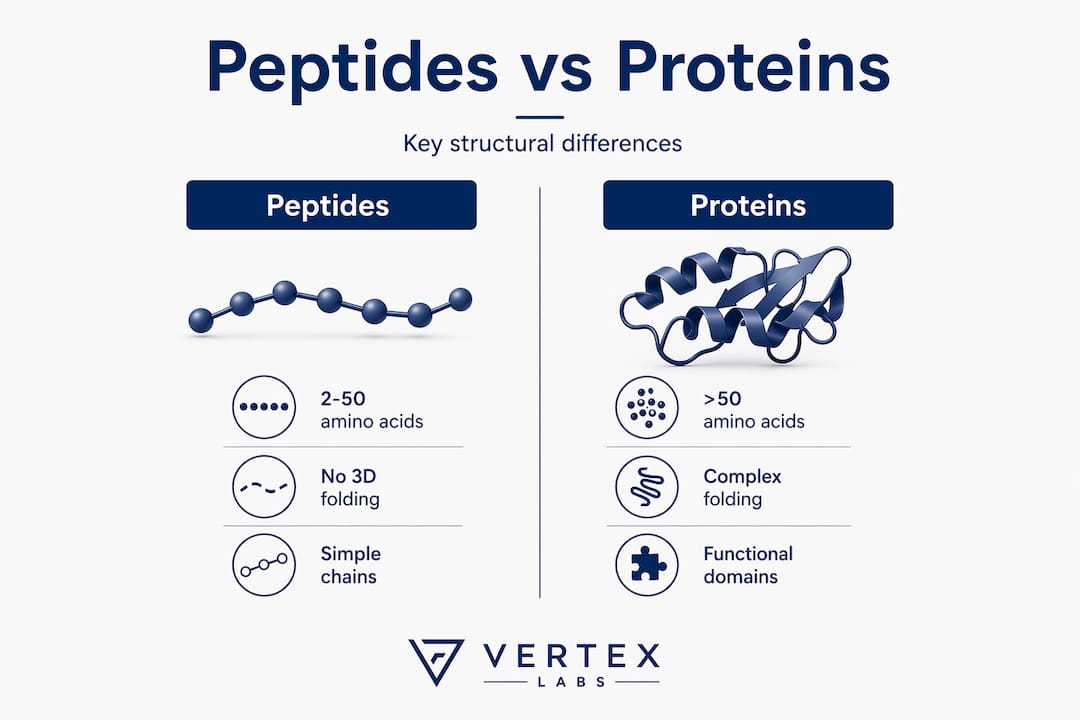
A peptide is defined as a short chain of two or more amino acids connected by covalent peptide bonds. The common working definition in molecular biology places the upper limit at approximately 50 amino acids, after which the molecule is classified as a polypeptide or protein. That boundary is not absolute across all literature, but it is the most widely used reference point in research contexts.

The peptide bond itself forms through a condensation reaction between the carboxyl group of one amino acid and the amino group of the next, releasing a water molecule in the process. In living organisms, ribosomes catalyze this process during translation. In laboratory settings, solid-phase peptide synthesis (SPPS) replicates this chemistry under controlled conditions, allowing researchers to build defined sequences with high precision.
What separates peptides from proteins is not just length. Proteins fold into complex tertiary and quaternary structures that define their function. Most peptides lack the length to adopt stable three-dimensional conformations under physiological conditions, which gives them different stability, half-life, and interaction profiles. Understanding this distinction is foundational for any researcher working with these molecules.
Pro Tip: When evaluating peptide literature, check whether the authors are using “peptide” and “polypeptide” interchangeably. Many papers do, which can create false equivalences in downstream experimental interpretation.
| Property | Peptide | Protein |
|---|---|---|
| Length | 2 to ~50 amino acids | >50 amino acids |
| 3D folding | Minimal to none | Complex and functional |
| Stability | Relatively lower | Higher, often stabilized by folding |
| Synthesis | SPPS or ribosomal | Primarily ribosomal |
| Typical function | Signaling, hormonal, regulatory | Enzymatic, structural, transport |
Types of peptides and how they are classified
Classification of peptides follows several overlapping frameworks, and basic peptide concepts become clearer once you understand that no single taxonomy covers all cases. The three most common approaches are size-based classification, origin-based classification, and functional classification.
Size-based classes:
- Dipeptides: Two amino acid residues. Carnosine is a naturally occurring example studied in muscle tissue research.
- Oligopeptides: Typically 3 to 20 residues. This range includes many signaling peptides with defined receptor targets.
- Polypeptides: 20 to several hundred residues. The line between polypeptide and protein is context-dependent but generally involves the capacity for functional folding.
Origin-based classes:
- Endogenous peptides are produced naturally within an organism. Insulin, oxytocin, and glucagon fall into this category.
- Synthetic peptides are produced in laboratories, either to replicate endogenous sequences or to create novel analogs for research purposes.
Functional classes in research contexts:
- Signaling peptides that activate receptor-mediated pathways
- Hormonal peptides that regulate metabolic and physiological processes
- Neuropeptides that function as neurotransmitters or neuromodulators
- Antimicrobial peptides studied for their role in innate immunity
- Synthetic analogs designed to probe specific receptor interactions
Research catalogs often include peptides such as TB-500, IGF-1 LR3, and Ipamorelin. These are studied in laboratory contexts for their receptor binding characteristics and signaling profiles. They represent synthetic research tools, not approved therapeutic agents.
Pro Tip: Changing a single amino acid in a peptide sequence can fundamentally alter its biological activity and safety profile. When comparing research data across studies, verify that the sequences are identical, not merely similar.
How peptides function as biological signaling molecules
Peptides explained simply at the functional level come down to one core concept: molecular communication. The body uses peptides as precision messengers that carry specific instructions from one cell or tissue to another. Their signal specificity derives entirely from sequence. Two peptides of identical length can have completely different physiological effects if their amino acid sequences differ.
The mechanism follows a pattern consistent across most signaling peptides:
- A peptide is synthesized and released by a source cell or tissue.
- The peptide travels through extracellular fluid, blood, or the nervous system to reach its target.
- It binds specifically to receptors on target cells, where the structural fit between peptide and receptor determines whether binding occurs.
- Binding triggers intracellular signal transduction, activating downstream pathways that produce a cellular response.
- The peptide is degraded by proteases, terminating the signal.
This receptor-binding specificity is precisely why sequence accuracy matters so much in research settings. Insulin, for example, is a 51-amino acid peptide that binds the insulin receptor with high affinity to regulate glucose uptake. Oxytocin, a 9-amino acid neuropeptide, binds oxytocin receptors in the brain and peripheral tissues to modulate a range of physiological responses. These functions are not interchangeable, and neither peptide would perform the other’s role at any concentration.
Peptides primarily act as biological signaling molecules, with specific amino acid sequences determining their function. Their roles span hormonal regulation, metabolic signaling, inflammatory response modulation, and neural communication. Each role depends on the precise sequence and the receptor environment in which the peptide operates.
Peptide synthesis and quality in research settings
Understanding peptides at the production level is critical for any researcher sourcing materials for laboratory studies. The dominant method for producing research-grade peptides is solid-phase peptide synthesis. SPPS involves sequentially coupling protected amino acids to a resin-bound chain, then cleaving and purifying the final product. The method allows production of virtually any defined sequence with control over length, modification, and purity.
Quality in research peptides is not a single metric. It involves several distinct parameters:
- Sequence accuracy: The correct amino acids must be incorporated in the correct order, verified through mass spectrometry or sequencing methods.
- Purity: Typically expressed as a percentage, with research-grade peptides requiring greater than 95% purity at minimum, and high-specification applications requiring greater than 99%.
- Identity confirmation: Independent analytical methods, such as HPLC and LC-MS, must confirm that the compound matches its stated structure.
- Batch traceability: Each production run should carry documentation linking it to specific synthesis conditions, raw materials, and analytical results.
- Certificate of Analysis (COA): A COA issued after third-party testing is the standard evidence document for research peptide quality.
The regulatory context requires clear understanding. FDA-approved peptides such as insulin and GLP-1 agonists have completed extensive clinical trials demonstrating safety and efficacy in human subjects. Research-use-only (RUO) peptides occupy a different category entirely: they are produced for laboratory and analytical use, not for human or veterinary administration. Conflating the two categories in sourcing or experimental reporting is a documentation and compliance error.
Grey-market research peptides carry documented risks including misidentification, contamination, and absence of safety data relevant to human exposure. For researchers, this reinforces why sourcing from suppliers with independent laboratory accreditation, verifiable COAs, and transparent batch documentation is not optional. It is a baseline standard for defensible research.
Pro Tip: Before placing a peptide order, request the COA from the specific batch you are purchasing, not a generic certificate. Batch-specific documentation is the only form of quality evidence that applies to the material you will actually use. For further context on what accreditation means for peptide suppliers, review lab accreditation standards.
Peptide applications in research and development
The significance of peptides in modern research extends across multiple disciplines. A foundational understanding of peptides maps directly onto understanding why they appear so frequently across molecular biology, drug discovery, and analytical chemistry workflows.
| Research Application | Role of Peptides | Common Analytical Tools |
|---|---|---|
| Receptor binding studies | Synthetic peptides as ligand probes | Radiolabeling, surface plasmon resonance |
| Hormonal signaling models | Endogenous and analog peptides to map pathway responses | ELISA, cell-based assays |
| Drug candidate development | Peptide scaffolds as lead compounds for therapeutic targets | LC-MS, HPLC purity analysis |
| Proteomics and sequencing | Tryptic peptides as protein fingerprints | LC-MS/MS, mass spectrometry |
| Antimicrobial research | Structural and functional characterization of host-defense peptides | Minimum inhibitory concentration assays |
In drug development pipelines, peptides serve as research tools before any compound reaches clinical evaluation. Researchers use peptide hormone research models to characterize receptor interactions, identify candidate compounds, and test hypotheses about signaling pathway behavior. This work happens entirely within laboratory environments and does not constitute clinical research.
Analytical characterization is a core component of peptide research at every stage. HPLC quantifies purity and detects impurities. LC-MS confirms molecular identity through mass-to-charge ratio analysis. These methods, when applied to well-documented materials from accredited sources, produce data that is reproducible and defensible. For more on identifying and confirming peptide sequences analytically, the sequence characterization methods resource provides a detailed technical reference.
My perspective on understanding peptides as a research tool
What I have observed consistently is that researchers who struggle most with peptide research are those who treat sequence data as secondary to availability. When you skip sequence verification and source based on price alone, you introduce a variable that cannot be controlled for in your experimental design.
The regulatory picture reinforces this. Chemical similarity does not imply equal regulatory status or evidence quality between FDA-approved peptides and research-grade analogs. I have seen this distinction overlooked in early-stage research planning, and it invariably creates problems in data interpretation and compliance documentation later.
My position is this: the science of peptides is genuinely interesting and the research applications are broad and legitimate. But the field only produces reliable knowledge when researchers apply rigorous standards to every material they introduce into their experiments. Evaluating peptides by regulatory status, available analytical data, and verified sourcing documentation is not bureaucratic overhead. It is the foundation of credible science.
Treat every new peptide material as an unknown until the COA and analytical data confirm otherwise. That standard protects your research and your institution.
— Vertex
Explore verified research peptides at Vertexpeptideslab
Vertexpeptideslab provides researchers and laboratory institutions with high-purity synthetic peptides manufactured under controlled synthesis conditions and verified through independent third-party testing. Every compound in the catalog is accompanied by a batch-specific Certificate of Analysis confirming purity greater than 99%, sequence identity, and full traceability from synthesis to delivery. The catalog includes research compounds such as TB-500, IGF-1 LR3, and Ipamorelin, available exclusively for laboratory and analytical research applications. Visit Vertexpeptideslab to explore the full research catalog and access COA documentation for each available compound. For information on what research-use-only status means for your laboratory, review the RUO compound guide.
For laboratory research use only. Not for human or veterinary use.
FAQ
What is the standard definition of a peptide?
A peptide is a short chain of amino acids linked by peptide bonds, typically containing 2 to 50 residues. Chains longer than this threshold are generally classified as polypeptides or proteins.
How do peptides differ from proteins structurally?
Peptides are shorter than proteins and generally do not fold into stable three-dimensional structures. Proteins, by contrast, fold into complex conformations that define their enzymatic, structural, or transport functions.
Why does amino acid sequence matter in peptide research?
Sequence specificity determines receptor binding and downstream signaling. Even a single amino acid substitution can change a peptide’s biological activity, which is why sequence verification is a required step before using any peptide in a study.
What distinguishes a research-use-only peptide from an FDA-approved peptide?
FDA-approved peptides have completed clinical trials that demonstrate safety and efficacy in humans. Research-use-only peptides are produced for laboratory analysis and have not undergone this evaluation process.
What documentation should researchers require when sourcing peptides?
At minimum, researchers should request a batch-specific Certificate of Analysis that includes HPLC purity data, mass spectrometry identity confirmation, and synthesis batch traceability. Generic or undated certificates do not provide sufficient evidence of material quality.